

Fertilizer is a source of nutrients that helps ornamental plants grow exceptionally well, including macro, secondary and microelements. Among them, NPK fertilizer is the top choice of many farmers. However, to achieve the best results, you need to understand how to apply NPK fertilizer to ornamental plants. . With Duc Binh Microbial Products learn how to use this type of fertilizer through the following article!
1. What effect does NPK fertilizer have on ornamental plants?
To help ornamental plants stay green and grow well, people not only focus on creating soil porosity and watering it sufficiently, but also use additional fertilizers. Currently, the market has many different types of fertilizers for ornamental plants, but the most popular is fertilizer NPK.

Understand correctly what NPK fertilizer is before knowing how to fertilize NPK for ornamental plants
It is known that NPK fertilizer is a synthetic fertilizer, composed of Nitrogen (N), Phosphorus (P) and Potassium (K). These are all factors that play an important role in plant growth. In particular, each substance has specific uses as follows:
- Nitrogen (N): a substance that helps ornamental plants grow strongly, stimulates the development of leaves and branches, and produces flowers and fruits.
- Phosphorus (P): a substance that plays a role in promoting root growth, supporting flower formation as well as enhancing the ability of ornamental plants to fight pests and diseases.
- Potassium (K): Potassium not only helps ornamental plants become stronger but also plays an extremely important role in the development of tubers, stems and fruits.
You can choose to use one of two types of NPK fertilizer: complex fertilizer and mixed fertilizer to fertilize ornamental plants. Although they have different names, both types provide a large amount of nutrients for ornamental plants. Thus, ornamental plants will grow quickly and have strong resistance to pests and diseases.
- Providing balanced nutrition: Depending on the NPK ratio, ornamental growers can choose the appropriate fertilizer for each stage of plant development (for example, NPK with high N content for the growth stage, NPK has high P and K content for the flowering stage).
- Soil improvement: Supplements necessary nutrients, helping to increase soil fertility.
- Increasing aesthetic value: Thanks to adequate nutrition, ornamental plants will grow green and healthy, produce beautiful flowers and leaves, and increase decorative value.
NPK fertilizer is indeed very good but may not bring the desired results when you use it incorrectly. So what is the most correct way to fertilize NPK for ornamental plants? Please continue to follow the next part of the article to learn how to fertilize NPK for ornamental plants to help them stay green!
2. Summary of 3 ways to fertilize NPK for ornamental plants
In fact, the way to fertilize plants with NPK is generally quite simple, not complicated and requires many techniques for growers. Accordingly, you can decide to choose one of three ways: soil fertilization, surface fertilization or foliar spraying after considering environmental conditions.

You have 3 simple, easy-to-implement ways to apply NPK fertilizer
With these 3 ways, we guarantee you will get good results when taking care of bonsai. To help you understand each method clearly, we will give specific instructions as follows:
2.1 Tell you how to apply NPK fertilizer to soil simply
This method is often applied to soluble fertilizers such as potassium or phosphorus (phosphate) found in NPK synthetic fertilizers. This is considered to be the most appropriate and effective way to fertilize. How to do this:
- Step 1: Make a few small holes in the ground surrounding the bonsai pot.
- Step 2: Pour NPK fertilizer into all the punched holes and then cover them with soil.
So, with just 2 simple steps, you have finished applying synthetic NPK fertilizer to the soil. Note that you should only apply a sufficient amount of fertilizer (not too much nor too little) and water immediately after fertilizing. By doing so, the fertilizer can quickly dissolve into the soil, providing nutrients for the plants.
2.2 Details on how to fertilize NPK for ornamental plants right on the surface
In the second method, you should consider using nitrogen fertilizer to achieve the desired effect. Like soil fertilization, surface fertilization is also extremely simple, without even needing specialized tools or any advanced techniques. How to do this:
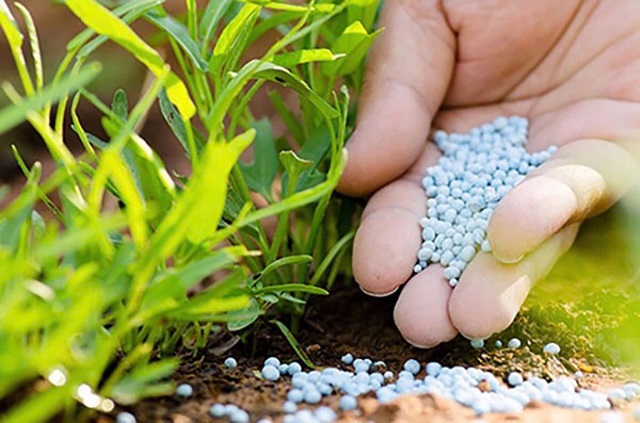
Fertilizing NPK for ornamental plants right on the ground is very common
- Step 1: Use your hand to spread NPK fertilizer evenly on the surface of the soil around the base of the tree to allow nutrients to be evenly distributed into the soil.
- Step 2: Use an additional layer of smooth, loose soil to cover the newly fertilized soil (should only cover a thin layer, not too thick).
If you do not prepare the soil, you can gently loosen the soil layer on the surface of the pot to spread the required amount of NPK fertilizer evenly. Then, you will have to mix the fertilizer very lightly into the tilled soil layer to quickly provide nutrients to the soil.
2.3 How to fertilize NPK for ornamental plants through foliar spray
This is the most suitable method of fertilizing for small ornamental plants that are still in the stage of development. Accordingly, you just need to mix NPK fertilizer with clean water and use a spray bottle to spray directly on the leaves. Although this method is very simple, growers must also ensure a good ratio of fertilizer and water for NPK to maximize its effect on ornamental plants.
If you mix too little fertilizer, the fish will not receive enough nutrients. On the contrary, if you mix too much fertilizer, it will burn the leaves and damage the plant. In this method of fertilizing, you also need to pay attention to watering the foliage evenly so that the plants can absorb the necessary nutrients well!
3. Before fertilizing NPK for ornamental plants, what should you pay attention to?

Some issues to note after knowing how to fertilize NPK for ornamental plants
As we have done share, if you do not know how to use NPK fertilizer properly, not only will it not be effective, it will It also causes serious damage to the tree. Therefore, for those who are new to bonsai and do not have much experience in taking care of plants, they need to pay attention to the following issues:
- Choose the right fertilizer: If ornamental plants are grown for the purpose of flower viewing, you need to pay attention to providing minerals and adding fertilizer to enhance leaf growth. On the contrary, you only need to use a sufficient amount of fertilizer to maintain the health of ornamental plants.
- Grasp the effects of each specific type of fertilizer: In how to fertilize NPK for ornamental plants, choosing the right type of fertilizer will optimize the health of the plant. In particular, Nitrogen plays an important role in leaf growth, Phosphorus helps improve root health and Potassium accelerates the flowering process.
- Fertilize plants at the right time: You can’t just fertilize whenever you want, but you have to adjust according to the season. When spring and summer come, plants often grow most vigorously, so you need to fertilize more often. In the fall, reduce the amount of fertilizer you need to provide and stop completely when winter comes.

Understanding the effects of fertilizer is essential when fertilizing plants
- Choose the right time of day to fertilize: Normally, fertilizing late in the evening will help nutrients penetrate deeper into the soil. From there, plant roots can easily absorb nutrients well at night. However, make sure the soil is tilled before fertilizing to keep air circulating and nutrients penetrating deep into the soil.
- Nutritional needs of each plant: Before fertilizing, you must understand the nutritional needs of the plants you are caring for. Depending on the stage of development and soil type, provide the appropriate amount of fertilizer.
⫸ See more: What is organic mulch? Structure, role and effective use
⫸ See more: 10 roles of organic and inorganic fertilizers on plants planting
4. Some taboos when fertilizing NPK for ornamental plants
In addition to following the correct fertilizing techniques for ornamental plants mentioned above, you must also pay attention to the following taboos:
4.1 Avoid fertilizing with concentrated NPK fertilizer
Too concentrated fertilizer means fertilizing with too high a concentration. Applying heavy fertilizer will cause bonsai roots to burn, reducing the tree’s ability to absorb water and nutrients. Ideally, when fertilizing we should dilute and mix in the right ratio. Note that you should not fertilize directly at the base of ornamental plants in large doses.
4.2 Avoid fertilizing when the soil is too hot.
Many people think that applying fertilizer during hot times will help the fertilizer dissolve faster. However, this view is completely wrong. Because when the soil is too hot, fertilizer will decompose too quickly and will cause nutritional imbalance in the soil. This reduces the effectiveness of fertilization, causing ornamental plants to lack nutrients and easily weaken.
4.3 Do not apply fertilizer directly to the base of ornamental plants.
Fertilizers, and specifically NPK fertilizers, should not be applied directly to tree stumps or bonsai roots. Because this action means you have damaged the tree roots. Instead of doing this, you should mix fertilizer with soil or water immediately after fertilizing. Only then will the ornamental plant absorb nutrients well and not shock the plant.
How to fertilize NPK for ornamental plants is quite easy, but you need to pay attention to a few issues to achieve the best results. Please contact Duc Binh Microbial Products via the link https://chephamvisinh.vn/ for more detailed advice on probiotics that are beneficial for plants!
Contact information
>
Address : 1B Alley 774 Kim Giang, Thanh Liet, Hanoi
Phone number: 0934.214.579
Email: chephamvisinhungdung@gmail.com
Website: https://chephamvisinh.vn


