
Organic fertilizerNot only does it help increase soil porosity and fertility thanks to its rich microbial flora, but it also adds many essential nutrients to help plants grow and develop smoothly. Currently, most garden owners have created their own source of quality organic fertilizer with simple compost binsminimizecosts in agriculture. If you also want to learn How to make your own organic waste compost bin, don’t miss this article!

Instructions on how to make your own organic waste compost bin very simply at home
1. Find out what a compost bin is?
A compost bin is a toolimportant needPrepare if you want to compost your own organic waste at home. Usually, organic compost bins are made from HDPE plastic to have high durability, good heat resistance and resistance to bad effects from the weather.
Besides, because it is made from virgin plastic beads, the compost bin is not harmful to users and is very friendly to the environment. Before composting, the body of the container will be drilled with round, spaced holesideally10 – 15cm to ensure ventilation.
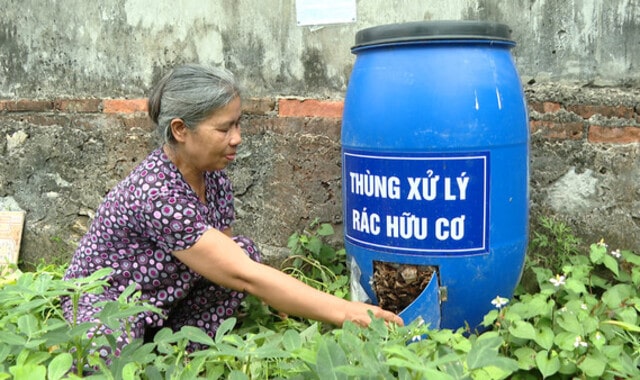
A compost bin is a mandatory tool that needs to be prepared
The bottom of the container, near the bottom edge, will be designed with a square door measuring 20 – 30cm to facilitate taking out the finished product. The compost bin has a relatively simple structure, you absolutely canMake your own organic waste compost binright at home to save costs.
2. Benefits of making your own organic waste compost bin at home
As we all know, storing a large amount of organic waste in the household for just a short time can cause a very unpleasant odor. But if properly treated with a compost bin, organic waste becomes an extremely good source of fertilizer for soil and plants.
Types of organic waste that can be stored in homemade compost bins include:
- Straw, stems, branches, leaves, grasses,husk…
- Coffee husks, sugarcane bagasse, tea grounds, peanut shells,sawdust…
- Types of scrap from fiber and paper in factories;
- Spoiled food, leftovers from the kitchen such as vegetables, fruits, meat, fish eggs…(Note: you should limit meat, fish, and fat to avoid attracting insects and creating bad odors).
- Fabric, cotton thread…
Besides, workMake your own organic trash canIt also brings great benefits such as:
- Pets will not be able to dig through organic waste;
- Flies, mosquitoes, ants and cockroaches will gradually decrease, helping to limit infectious diseases carried by insects;
- Minimize the amount of waste released into the environment;
- Obtain quality organic fertilizer to fertilize soil and plants;
- Significantly reduce costs in agriculture;
- By limiting the use of chemical fertilizers, soil erosion and leaching are reduced, protecting the environment and human health.
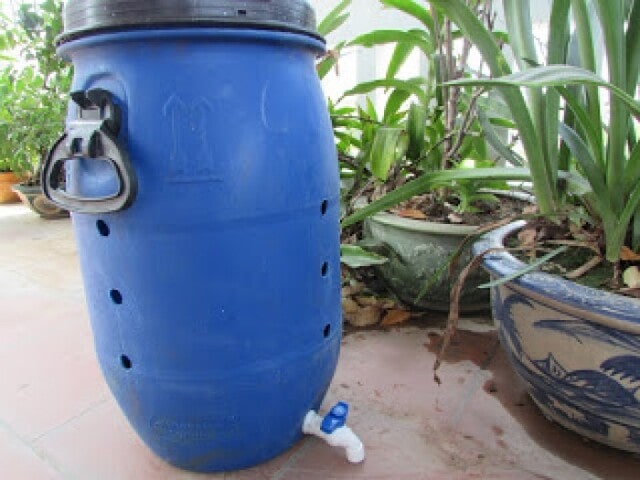
Making your own compost bin for organic waste has many benefits
In short,Organic waste composters bring many practical benefitsevery family. So what are you waiting for? Start creating organic compost bins right at home. Right here is a simple guide to making organic barrels, please refer to it!
⫸ See more:How to compost organic waste without odor is extremely simple
3. Extremely simple instructions for making your own organic waste compost bin
The compost bin is a simple device that turns organic waste into fertilizer for plants. There are many ways to make a compost bin for organic waste, depending on the conditions and needs of each family.
Here are some popular ways to make organic compost bins:
Method 1: Compost organic waste from plastic bins
This is the simplest and most popular way to make a compost bin for organic waste. You just need to prepare a plastic container with a tight lid, the size appropriate to your needs. Then,rememberMake drainage holes in the bottom of the barrel to prevent the barrel from being floodedor stagnation of waste fluid.
Method 2: Compost organic waste from Styrofoam boxes
Composting organic compost in a foam bin is also very simple. Styrofoam is also a popular and easy to find material for making organic waste compost bins. You just need to cut the foam box into two halves, then join them together with glue or tie. Poke drainage holes in the bottom of the container and close the lid tightly.
Method 3: Wooden organic waste compost bin
Wooden organic waste bins are more durable than plastic or foam compost bins. You can buy a wooden organic compost bin or make your own wooden organic compost bin following instructions online.Be sure to choose wood that is termite-free and has good moisture resistance.
Method 4: Compost organic waste from metal bins
Metal organic waste compost bins have good heat resistance, suitable for hot climates. You can buy a metal compost bin or make your own metal compost bin using instructions online.It is necessary to ensure that the barrel is not rusted to avoid affecting the quality of the fertilizer.
Making your own organic compost bin at home is not difficult3 basic preparation steps and 4 incubation steps, you will immediately have the compost bin you like:
Step 1: Choose a type of organic waste compost bin
You can design your own or buy a plastic bin with a tight lid to use as a compost bin. Old plastic barrels or drumsabsolutely possibleused as a compost bin. However, organic waste compost bins need to have a lid to ensure soil moisture in the bin, limit flies and insects from flying in,and prevent odors from escaping.
Note: In the lid of the compost bin, you need to punch 8 – 10 holes to allow air to circulate in the bin. At the same time, the lid of the bin also needs to be labeled, clearly stating the time to start composting to make it easier to track and retrieve the finished organic fertilizer.
Step 2: Drill holes in the barrel body and create a door near the bottom of the barrel to get the finished product
Use a sharp object or drill 8-10 holes around the barrel body to allow air to circulate inside the compost binmax. At the same time, design a square door measuring 20 – 30cm, with a fixed lock for convenient removal of finished products.
So, with just a few simple steps, you have created your own organic waste compost bin. The next step is to compost organic waste to create a source of fertilizer that is good for soil and plants, safe for humans and environmentally friendly.
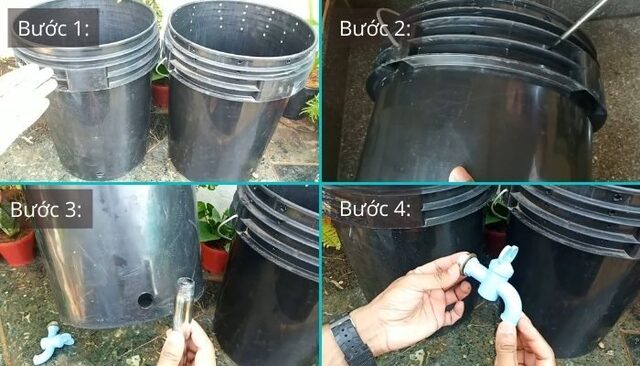
Making your own organic compost bin at home is really simple
Step 3: Create base layer
You can use sawdust, dry leaves or shredded newspaper to put in the bucket, filling about ⅛ to ¼ of the bucket to create a base layer. Next, spread 5 to 10cm of loose soil on top of that layer. All of the above ingredients are very easy to find. You will not encounter any difficulty at all at this stage.
Step 4: Start composting
Prepare tools and ingredients
In order for the process of composting organic waste to be 100% successful, in addition to a standard compost bin, you need to prepare the following items:
- Gloves;
- Shovel;
- Waste of vegetable origin, leftover food from the kitchen;
- Scissors to cut waste(Garbage should be shredded to speed up decomposition);
- Molasses;
- EMZEO microbial product for composting (Specialized probiotics for composting trash and deodorizing).
Start composting
After you have prepared all the above tools, you start putting organic waste into the bin. You can put vegetables, stems, leaves, food scraps, tea grounds, coffee grounds, eggshells, etc. into the compost bin. Corresponding to each layer of organic waste, you add a sufficient amount of biological products. For every 70 – 100kg of organic waste, you should use 1 package of EMZEO 200gr composting yeast and 1 liter of molasses.
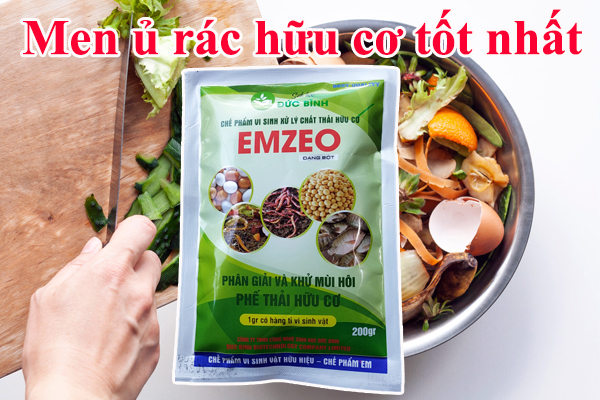
Microbial product EMZEO helps significantly shorten organic composting time and eliminate odors
Next, add molasses and use a shovel to stir the ingredients and biological products evenly in the compost bin. You can spray more water into the compost bin to create moisture for the compost, but do not pour too much water to avoid causing unpleasant odors during the composting process.
Attention:You should only add waste of plant origin to the compost bin.Should be limited as much as possibleput animal manure, things with bones, quicklime,dairy products and animal fats… Becausethesecan cause more unpleasant odors to the compost bin and form harmful bacteria in the compost.
Step 5: Find a location for the organic waste compost bin
Composting organic waste after adding probiotics and molasses will minimize the smell of waste. Therefore, you can place the compost bin right on your balcony or porch (if you live in an apartment or house without a backyard). At the same time, the location where the compost bin is placed should not be exposed to direct sunlightBecause too high a temperature can kill microorganisms.
However, when waste begins to decompose, it inevitably smells and attracts insects, etc. So if possible, the best location for an organic waste compost bin is a shady place, far from living areas.
Step 6: Collect more organic waste
At the end of step 5, the composting process with a homemade compost bin is considered complete. But if you collect more trash every day, you can still add it to the compost bin. With each additional layer of ingredients, youA small amount should be addedmicrobial products and molasses to speed up the decomposition process.
Step 7: Collect finished organic fertilizer
The composting period lasts from 30 – 40 days. You can open the door below the bin to get to the finished compost. During the composting process, water can formGarbage leakage (also known as garbage epidemic). You can use this water to water plants(Need to dilute at a ratio of 1:10 or more depending on the type)Or pour it back into the compost bin if you feel the trash in the bin lacks moisture.
⫸ See more:How to compost kitchen wastemake organic fertilizer for plants
⫸ See more:Benefits and how to use rice water to water plants
4. The secret to making the organic waste compost bin work effectively
In order for the composting process to go quickly, the finished product to be of high quality and not cause unpleasant odors, you need to keep in mind the following tips:
4.1 Balancing “Green” and “Brown” materials
This is the golden rule in composting.
- “Green” ingredients (contains a lot of Protein – Nitrogen):These are fresh, moist materials such as vegetables, young grass, coffee grounds, and manure. They help microorganisms thrive.
- “Brown” material (contains a lot of Carbon – Carbon):These are dry, hard materials such as dry leaves, straw, sawdust, and shredded paper. They help create porosity and ventilation.
- The ideal ratio is approx2 parts Brown: 1 part Greenby volume. Balancing will help keep the compost pile from being too wet (causing bad odors) or too dry (slowing down the decomposition process).
4.2 Cut ingredients into small pieces
Cutting or crushing organic waste (especially tree branches and hard fruit peels) will increase the contact area, help microorganisms decompose faster, and shorten composting time. This chopping also helps distribute the materials more evenly in the compost bin, creating favorable conditions for microorganisms to function uniformly. Ideally, the materials should be no more than 2-3 cm in size.
4.3 Stir regularly
Periodic mixing (about 1-2 times/week) is very important. Turning helps provide oxygen to aerobic microorganisms, increases the temperature of the compost pile (which helps kill pathogens and weed seeds) and ensures that materials are decomposed evenly.
When mixing, you should move the outer material to the middle and the middle material outward to ensure the entire compost mass receives the necessary high temperature. If not stirred, the compost easily becomes anaerobic in the middle, which slows down the composting process and can create an unpleasant odor.
4.4 Humidity control
The ideal humidity for a compost pile is about 50%-60%, equivalent to the moisture of a wrung-out sponge. If it is too dry, the incubation process will slow down; If it is too humid, it will cause anaerobic and odorous conditions.
You can check the moisture level by holding a handful of ingredients and squeezing firmly: if the water just leaks out between your fingers, it’s done. If it’s too dry, add more water (preferably water mixed with probiotics). On the contrary, if it is too wet, add dry, carbon-rich ingredients such as sawdust and dry straw to absorb moisture.
4.5 Temperature monitoring
During the first few weeks, a good compost pile will reach high temperatures (55oC-65oC) due to strong microbial activity. This is a sign that the incubation process is proceeding successfully.
High temperatures are important to decompose cellulose and destroy pathogens, insect eggs and weed seeds hidden in waste. After the temperature drops to nearly the ambient temperature, it means the annealing process has entered the completion stage.
⫸ See more: How to compost organic fertilizer from vegetables and foodExtremely fast, 100% successful
⫸ See more: What is organic fertilizer? Uses and How to make organic fertilizer for plantsright at home
5. Frequently asked questions when making your own organic compost bin at home
5.1 Why should you make a compost bin for organic waste?
- Helps treat organic waste instead of dumping it, reducing environmental pollution.
- Create high quality microbial organic fertilizer for plants.
- Save costs on buying fertilizer and waste treatment.
- Practice skills and awareness of environmental protection.
5.2 What size household is the compost bin suitable for?
- Household of 1-3 people: 20-30 liter box.
- Household of 4-5 people: 50-80 liter box.
- Over 5 people: 100 liter box or more.
5.3 How long does it take for organic fertilizer to be created?
- About 20 – 30 days if using EMZEO composting yeast and molasses
- In hot summer, the decomposition process is faster.
- In cold winter the process is slower.
5.4 Signs of ripe organic fertilizer?
- The color is dark brown, the original ingredients are no longer recognizable.
- There is a smell of damp soil, no more stench.
- Has a spongy, loose and dry structure.
- PH level 6-7.
5.5 How to preserve and use organic fertilizer?
- Put it in a box or sack to protect it from rain and keep it moist.
- Use as fertilizer for flowers, vegetables, tubers, and fruits.
- Mix with soil to improve soil before planting.
- Sprinkle around the base of the tree, combine with watering.
Make a compost bin for organic wasteAt home is a simple and effective method to treat organic waste and reduce environmental pollution. Above is the wayMake your own organic waste compost binSimple and easiest to do right at home. However, to make the organic waste composting process faster, reduce unpleasant odors, and ensure quality finished compost, you need to add the probiotic product EMZEO and molasses. You can order online onMicrobial product Duc Binh for delivery to your home.
Contact information
Duc Binh Biotechnology Co., Ltd
Tax code: 0108433217
Address: 57 Lane 64 Kim Giang, Khuong Dinh, Hanoi
Phone number: 024.66.55.46.86
Transaction office
Microbial products Duc Binh – Center for research and application of biological productsspecializes in research, production and application of product lines: Probiotics, septic tank enzymes, wastewater treatment enzymes, aquatic enzymes, biological products…
Address:1B Alley 774 Kim Giang, Thanh Liet, Hanoi
Phone number: 0934.214.579
Hotline: 024.66.55.46.86
Email:chephamvisanhungdung@gmail.com
Website:https://chephamvisinh.vn


