
Not everyone knows how to use trichoderma mushrooms most effectively for different types of plants or flowers. Why is that? How to use trichoderma mushroom “properly” with the highest efficiency Trichoderma mushroom has long been considered the antidote to diseases such as yellow leaves, root rot… Therefore, trichoderma medicine is used extremely widely in agriculture. However, not everyone knows how to use trichoderma mushrooms most effectively for different types of plants or flowers.
What is trichoderma mushroom, what are its uses?
Want to learn how to use trichoderma mushroom, you should also know what this mushroom actually is and how it works, right!
What is trichoderma?
First of all, it must be confirmed that this is a type of mushroom. However, unlike other fungi that are harmful to plants, trichoderma has the ability to oppose and control other pathogenic fungi. It also kills many major root rot fungi such as: Pythium, Rhizoctonia and Fusarium. In other words, trichoderma fungus is considered a “natural enemy” of harmful fungi. Therefore, currently, the most effective and safe fungicides include preparations containing trichoderma.

Trichoderma fungus is considered a natural enemy of harmful fungi
Trichoderma fungi reproduce asexually at an exponential rate (sexual reproduction is very rare). Mushrooms grow strongly at temperatures from 25 – 30 degrees Celsius. The life cycle of mushrooms is quite long, surviving in a favorable environment for about 18 months. However, trichoderma can still be easily destroyed if exposed to intense sunlight for 2 hours or when it rains for many days.
See details in the article: What is Trichoderma? Where to buy trichoderma mushrooms
Uses of trichoderma mushroom
- Extremely effective treatment of yellow leaves and root rot
When using trichoderma mushrooms on plants, they will secrete a special enzyme. This enzyme dissolves the cell walls of other fungi. Next, the trichoderma fungus can attack inside the harmful fungi and destroy them.
Thanks to this mechanism, trichoderma mushroom preparations will protect the root zone of plants, against fungi that cause root rot and yellow leaves in the most effective way.
- Increases plant resistance
Trichoderma fungi attach to plant root areas like other symbiotic organisms. This way of growing benefits both. Trichoderma fungus secretes stimulants into the soil so that plant roots grow deep into the ground. This helps plant roots become stronger and better able to absorb nutrients. When the roots develop well, the plant will be provided with a lot of energy to grow.
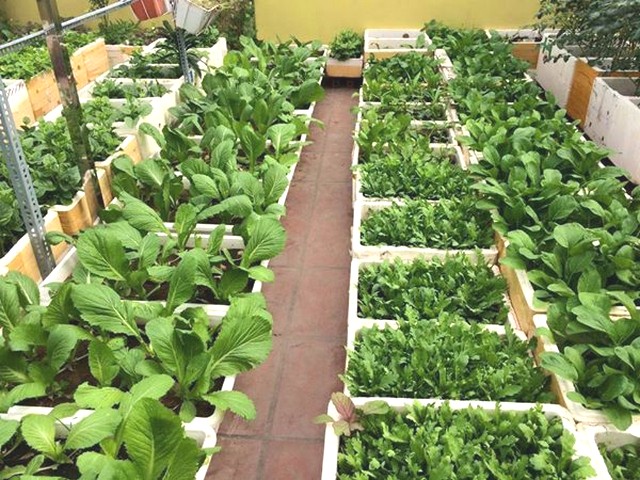
Trichoderma fungus treats leaf yellowing, root rot, and promotes good plant growth
Not only that, Trichoderma fungus helps increase defense capabilities, like an “invincible” armor that protects plant roots from the invasion of fungal diseases
- Helps decompose fibers quickly
Activity of trichoderma fungus. It also promotes the decomposition of fibers such as leaves… a quick way to provide nutrients for plants. That’s why people often mix this mushroom with organic fertilizer, this will help the organic fertilizer decompose and decompose faster.
There are many ways to use trichoderma for plants, it can be used directly or mixed with other fertilizers. For each type of plant, the dosage of mushrooms used will be different. Specifically, please refer to the section below.
How to use trichoderma
Today, trichoderma mushroom preparations are widely used in many different ways. Specifically, there are 3 main methods such as:
3 ways to use trichoderma
Use direct fertilizer
Using trichoderma fungus to directly fertilize crops is very simple and quick. This method of use is currently used by many households because of its convenience, without having to wait for incubation time.
Specifically, if people want to grow seedlings, they will use a trichoderma mushroom product mixed well with the growing medium before adding the nursery pots. Thanks to the root protection mechanism of this fungus, the nursery will grow as healthily as possible.
For crops such as vegetables or fruit trees…trichoderma fungus is mixed with organic fertilizer to fertilize 1-2 times/crop for short-term plants and 1-2 times/year for perennial plants. If the weather is favorable, you may only need to fertilize once. But if the weather is not favorable such as long days of intense sunshine or prolonged rain, you should fertilize a second time to add new mushrooms to replace the dead ones. Thanks to that, the tree is always healthy.
Trichoderma fungus
This is also a way to use trichoderma mushrooms that is extremely simple, quick, and doesn’t take much time. Accordingly, you just need to mix the mushroom product with water according to the instructed ratio and then water it directly at the base of the tree.
Incubate mushrooms with other fertilizers
As mentioned, trichoderma fungus has the ability to quickly decompose fiber. Therefore, this type of mushroom is popular for composting with manure and plant residues. Depending on the manufacturer, there will be different incubation instructions. But basically you can refer to the incubation method used by many people as follows:
People mix a certain amount of mushrooms (according to the instructions of each manufacturer) with super phosphate, manure and plant residue. Next, spray the urea nitrogen solution mixed with water into the compost pile to wet it evenly. Use your hands to squeeze the mixture tightly and see if the water oozes out. It should not be too wet nor too dry. Then mix well and incubate the canvas.
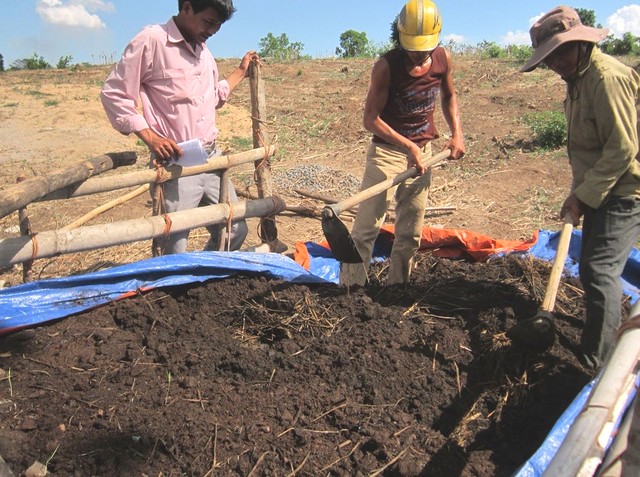
Incubate trichoderma mushrooms with manure and organic matter
After 4-5 days, stir and check the moisture. If it feels dry, spray water on it to create humidity. After 25 – 30 days, continue to stir and check the moisture. If dry, spray water to ensure moisture is 50 – 55% (ie wring it out and seep out the water). If the manure is completely decomposed, it can be used. If not, continue incubation until 30 days later.
3 how to use mushrooms trichoderma can be used on all types of plants. However, for each type of crop, people prioritize using certain methods. Specifically, please see the instructions for using trichoderma fungus medicine for each type of plant as follows.
See more: Trichoderma – the optimal biological fungal disease prevention method
How to use trichoderma medicine for each type of plant
Each type of plant has different biological characteristics. Therefore, when using trichoderma mushrooms for them, you should also consider which method should be given priority.
How to use trichoderma fungus for vegetables and industrial crops
Vegetables and industrial plants are plants with quite high economic value. However, during the process of growing them, many times farmers lamented the raging yellow leaf disease and root rot, causing the trees to die and productivity to decrease. However, if you know about the medicine to treat yellow leaves and root rot from trichoderma fungus, this will certainly no longer be a problem.
Using trichoderma fungus for vegetable crops and industrial crops, you can use all 3 methods above. However, with vegetable crops, direct fertilization is preferred. For industrial crops, the method of composting mushrooms with manure and plant remains is used more. What is the reason?
Vegetable plants have a fairly short life cycle, usually only after 2-3 months they will be harvested. Therefore, composting will take too long, so people will take advantage of the period of applying basic fertilizer to mix trichoderma mushroom preparations together.
As for industrial plants, due to their long life cycle, usually several years or decades, the care process requires periodic provision of nutrients. Disease control also needs to be done regularly. Therefore, composting mushrooms with manure and organic matter will provide more nutrients for plants, more effectively and can be done every 6 months.
Using trichoderma fungus for flowers: orchids, roses
Orchids or roses are often grown in ornamental pots, the area is quite small so people often use the trichoderma method of watering the roots. Just mix the mushroom product with water and water the plants.
The activity of fungi will help flowers grow better because the roots are well protected. The root system is extremely important for flowers, especially orchids. Not only that, thanks to its ability to promote the decomposition of organic matter and humus, this fungus will help flower plants get more nutrients to grow and develop well.

How to use trichoderma mushrooms for orchids and roses
Anyone who loves flowers and is interested in growing flowers should “keep” a few bags of biological products of fungi against trichoderma.
Which type of trichoderma mushroom product is good and cheap to buy?
Because trichoderma mushroom has many uses and is widely used, there are many manufacturers of biological products made from this mushroom on the market. However, Duc Binh company’s products are still one of the most highly appreciated and popular products in the market.
Duc Binh – The best brand for producing trichoderma mushroom biological products
Duc Binh’s trichoderma mushroom preparation currently has 2 types: trichoderma antagonist mushroom and a combination product between trichoderma mushroom and bacillus mushroom. Trichoderma and trichoderma bacillus mushroom preparation are not only two common fungicides but also It is also considered an indispensable supplement for plants.
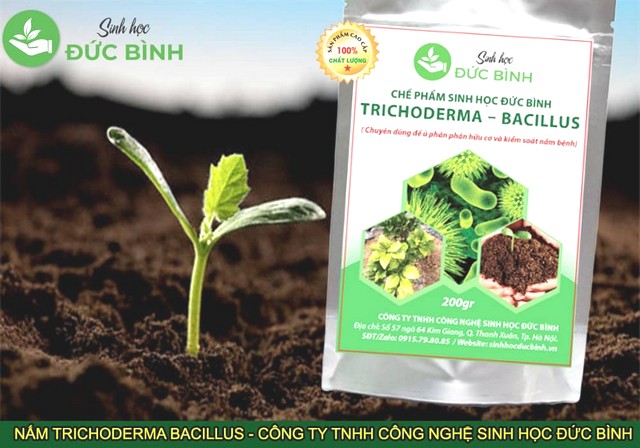
Duc Binh trichoderma mushroom product
Duc Binh‘s products have many outstanding advantages compared to other types on the market. Because it is produced specifically for each purpose.
- Type used for irrigation (antifungal preparations against trichoderma)
- Type used to compost or directly mix trichoderma mushroom preparations. This type of preparation, in addition to the trichoderma fungus group, is also supplemented with the Bacillus sp group of microorganisms to increase the ability to decompose organic matter as well as control pathogens.
Both trichoderma mushroom preparations also have unique advantages such as:
- It is a spore-form product, with a very high density of fungal spores (1 gram has billions of spores, thereby saving the amount of medicine that must be used)
- In addition to treating the pathogenic fungi listed above, this product can also prevent powdery mildew, downy mildew…
- Can be used for most crops: pepper, coffee, fruit trees, tomatoes, potatoes, grapes, vegetables, roses, orchids, strawberries, asparagus…
- Composting decomposes quickly, reducing composting time compared to conventional products. In particular, composting does not have a bad smell
Dosage for Trichoderma Duc Binh
As mentioned, Duc Binh’s trichoderma mushroom preparation has a high amount of fungal spores, so the dosage used is much less than other preparations. Specifically, you should refer to the recommended dosage as follows:
How to use trichoderma preparations in combination with bacillus
- With the method of composting with organic matter:
- Just mix 2 – 3 packages of trichoderma bacillus mushrooms (200gr) with 20 – 30 liters of clean water, water evenly on organic waste. Then spray more water to achieve the right humidity. (i.e. use your hands to squeeze until water leaks out)
- Stir the organic waste well, create a pile and cover for composting
- Incubation time is about 25 – 30 days before it can be used
Because the amount of mushroom spores in Duc Binh’s preparation is large, the incubation time is much shorter than other preparations.

Type of trichoderma mushroom preparation used for incubation and direct fertilization
- For direct fertilization method.
How to use trichoderma – bacillus Duc Binh mushroom as follows:
You only need to mix 3 – 5 packages of trichoderma bacillus mushrooms How to use trichoderma mushrooms (600g – 1kg of this product is only 1/3 of other trichoderma mushroom products (normal) with 1 ton of organic fertilizer and then fertilize the plants. In addition to killing fungi and decomposing organic matter, trichoderma mushrooms are also used as an effective method of treating contaminated soil.
Specifically, to treat contaminated soil, just mix 1 package of Duc Binh trichoderma bacillus mushroom product with ash or 2kg of fused phosphate and sprinkle evenly on the ground. Cover the soil with a layer of ash or distributed fertilizer, water it every day to keep it moist. After a period of time, under the activity of microorganisms, the soil will be cleaned and crops can be grown again.
Dosage of Duc Binh trichoderma mushroom in spray and irrigation form
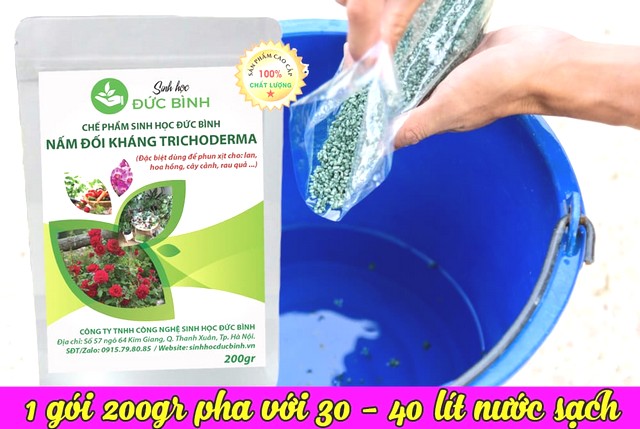
Duc Binh trichoderma mushroom used for irrigation and spraying
If mixing trichoderma fungus to spray and water the roots, you only need to use 1 200gr package mixed with 30 – 40 liters of water. If mixed with biological proteins, mix according to the formula of 1 package of mushrooms plus 1 liter of biological protein and 40 liters of water then spray on leaves, soil or water the roots.
Duc Binh trichoderma mushroom quote
With many outstanding advantages, it is much more economical to use than conventional trichoderma mushroom preparations. But the price of Duc Binh trichoderma mushroom is extremely attractive. Specifically, the prices of 2 types of antagonistic trichoderma mushroom preparations used for spraying and irrigation and the trichoderma – bacillus preparation used for composting and direct fertilization are the same price of 30,000 VND/package of 200gr.
Customers who need further instructions how to use trichoderma mushroom Duc Binh or want to buy the product, please contact us immediately for support.
EM Bio-Product
Aquaculture Probiotics
Aquaculture Probiotics
Aquaculture Probiotics
Organic Bio-Fertilizer


See more: How to use EM preparation


