

The method of composting organic fertilizer from leftover food is currently applied by many people and has successfully created a source of quality, cheap organic fertilizer. This type of fertilizer is not only a great source of nutrients for plants but also adds a large amount of beneficial microorganisms to help improve the soil and create safe food for users. Let’s Duc Binh Microbial Products compost organically from vegetables and leftover food in your own family!
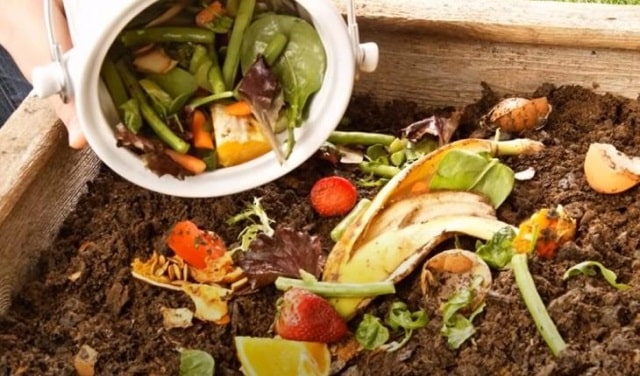
How to compost organic compost from vegetables and leftover food extremely quickly, 100% successful
1. What is organic fertilizer from food scraps?
The way to compost organic food waste is to use leftover ingredients from the kitchen such as: fruit peels, vegetable peels, egg shells, coffee grounds, paper, tea bags, rice water,… and ferment. After a while, we obtain a 100% natural fertilizer, extremely useful and safe for flowers, vegetables or ornamental plants,…
Composting organic fertilizer from vegetables is a simple and effective way to take advantage of organic waste, while providing natural fertilizer for plants, effectively improving degraded soil. Organic fertilizer from vegetables has high nutritional content, helping plants grow healthily. In addition, composting also helps reduce environmental pollution.
2. Advantages and disadvantages of organic fertilizer from food waste
Advantages of organic fertilizer composted from food scraps:
- The cost of creating finished products is low because the input materials are all surplus right in the kitchen;
- Soil fertilization helps increase soil fertility and porosity
- Helps stabilize soil structure;
- Supplements essential nutrients for plants and soil;
- Limits soil erosion and discoloration;
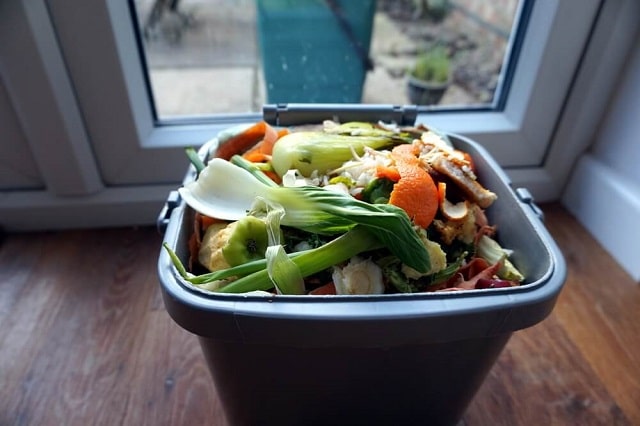
Organic compost made from vegetables and food scraps has many advantages
Disadvantages of compost made from food scraps:
- The content of nutrients in feces is relatively low;
- It takes quite a while to wait for the ingredients to decompose;
- If the composting process is not done properly, it will cause unpleasant odors and can create unwanted pathogens on plants;
3. The secret to composting high-quality food scraps
Although organic fertilizer composted from vegetables and food scraps has many advantages, bringing many benefits to farmers, this type of fertilizer still has some disadvantages. And to overcome all the above disadvantages, in how to compost organic food from vegetable scraps, families should add biological products.

Organic composting from vegetables and leftovers is indispensable for biological products
Because emzeo biological products contain a large number of microbial strains that help quickly decompose leftover food and vegetables into clean nutrients. In particular, the biological product emzeo helps eliminate unpleasant odors during the composting process. Thanks to that, you will obtain high quality organic fertilizer, very good for plants and soil.
In addition, you should also choose a variety of vegetables and leftovers as raw materials. Combine with microbial products to create an organic fertilizer capable of providing a full range of macro, micro and secondary elements for plants, helping farmers save costs.
4. Simple way to compost organic food scraps right at home
There are many different ways to compost organic food scraps, but using molasses and Emzeo composting yeast is the most effective while also eliminating odors from vegetables and leftover food. The steps to compost organic compost from vegetables and leftover food right at home are as follows:
Step 1: Choose the right probiotic
As shared, the secret to successfully composting organic fertilizer from vegetables and leftover food is to use a combination of microbial products. However, there are many on the market, you need to choose the right type of probiotic that both speeds up the composting process and effectively eliminates odors.
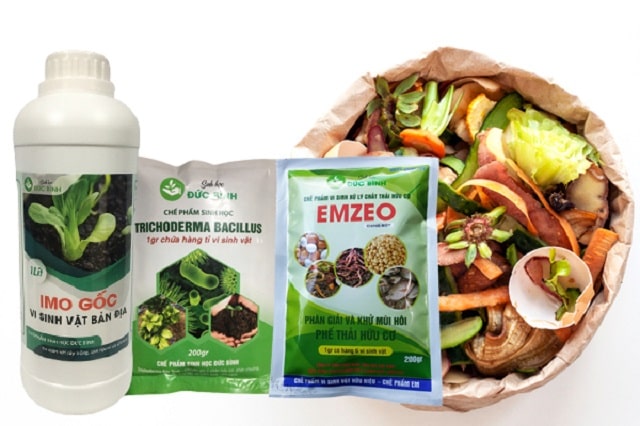
Biological products and molasses effectively eliminate odors and help shorten composting time
Currently, there are a number of highly appreciated biological products such as: Original EM product – EMGRO, IMO product, EMZEO product, Trichoderma Bacillus mushroom. These are all types of probiotics that have the ability to kill harmful bacteria, worm eggs, deodorize and promote the decomposition of materials. You can choose any type.
Step 2: Prepare ingredients
For the composting process from food scraps to proceed quickly and for the finished compost to meet quality requirements, you need to prepare the following materials:
- Leftover vegetables, fruit peels, eggshells, vegetable stems, leftovers, coffee grounds, tea grounds, soybean grounds, coconut grounds,…
- Concentrated molasses: 1 liter
- EMZEO biological products: 1 pack of 200gr
- Containers for composting can use paint buckets, plastic buckets, wooden buckets, etc. with lids
- Masks, gloves, cutlery to cut organic waste, shovel to stir ingredients

How to compost organically from vegetables and leftover food with 100% success
Step 3: How to compost organic food scraps in detail
- First, you need to mix all the vegetable ingredients and leftovers collected above. Mix molasses water: 1 liter of molasses mixed with 5 liters of water
- You sprinkle a layer of biological product on the bottom of the container. Next, put a layer of vegetables and leftover food 4 – 5cm thick into the bin, mixed well on top. Water the molasses evenly
- To ensure the fermentation process, you need to ensure the humidity of the ingredients in the barrel is only 45 – 50%. If the ingredients are too wet, you need to remove some of the water.
- Next, sprinkle another layer of EMZEO probiotic on top of the ingredients. You add the vegetables and leftover food into the box, sprinkle probiotics on top. Keep doing this until you run out of ingredients.

The process of composting organic compost from vegetables and leftover food is not too complicated
- Every day, if you have vegetables or leftovers, you can add them to the container. Each time you add such ingredients, you sprinkle a layer of EMZEO product on top.
- You need to add molasses to the container to promote fermentation, decompose waste and eliminate odors. Every 70 – 100kg of organic waste corresponds to 1 liter of molasses and 1 200gr package of emzeo yeast.
- After putting all the ingredients in the container, close the lid and let it ferment for 15 to 20 days. You place the compost container in a dry, cool place with stable temperature, away from direct sunlight.
4. How to use organic fertilizer from leftover food
Organic fertilizer from leftover food, vegetables… can be used for many types of crops, including:
- Vegetables
- Flower
- Ornamental plants
- Fruit trees
- Improving degraded land …
Actually, there are 2 ways to use organic fertilizer made from vegetables and leftover food as follows:
- Method 1: Mix organic fertilizer well with soil (soil prepared for planting new plants). You mix the ratio 1:3 soil and you can plant plants directly.
- Method 2: Mix composted manure to water plants. After the incubation period, you drain the compost water into another bucket to use to water the plants. For the residue in the barrel, you can fertilize the plant directly with a sufficient dose.
5. Some notes when composting organic compost from leftover food
How to compost organic food scraps is not difficult at all, but during the composting process, you need to keep in mind a few small notes:
- Composting organic compost from vegetables and leftover food needs enough time for the ingredients to decompose and eliminate pathogens. During the incubation process, you must always monitor to maintain humidity in the container to ensure a quality finished product.
- All leftovers contain grease, you must pour water into the leftovers, remove the grease before putting the ingredients into the compost bin.
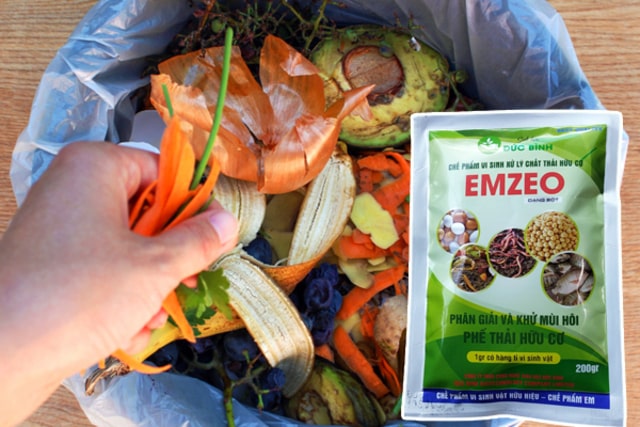
Organic fertilizer composted from vegetables and leftovers to ensure quality with EMZEO biological products
- The composting time is from 15 to 20 days, but if you want an even shorter time, you can increase the amount of molasses and emzeo microbial product.
- You can add moisture to the ingredients by adding water or rice water but do not add too much, always maintain the humidity in the container from 45 – 50%.
Above are detailed sharing abouthow to compost organic fertilizer from vegetables and leftover food, how to use organic fertilizer composted from vegetables and leftover food along with some notes during the composting process. Hopefully with the information in the article, you can create high-quality organic fertilizer products from vegetables and food scraps.
6. Frequently asked questions about composting food scraps
6.1 Why should you compost organic matter from vegetables and leftover food?
- Save costs on buying fertilizer for the garden.
- Handle organic waste, reduce environmental pollution.
- Organic fertilizer is rich in nutrients, good for soil and plants.
6.2 Which ingredients should not be added to compost?
- Meat, fish, animal bones: easily cause bad odors and attract insects.
- Fat, grease: slows down the decomposition process.
- Confectionery, spicy spices: can inhibit microorganisms.
6.3 What is the ideal moisture level for composting?
- About 50-60% is ideal for microorganisms to grow well.
- Moisture should be maintained by watering regularly, avoiding too wet or dry.
6.4 How long after composting can you harvest manure?
- After 2-3 months, compost can be harvested for use.
- If you want the compost to ripen and compost more thoroughly, leave it for 3-5 months.
6.5 What are the signs that compost is ripe?
- Evenly dark brown color.
- There is a slight foul smell typical of organic fertilizer.
- Smooth spongy texture, the original ingredients are no longer recognizable.
7. Conclusion
Composting organic compost at home from vegetable waste and food scraps is a simple, economical and effective method. Through this article, we hope everyone can grasp the detailed instructions on how to compost food scraps properly. Applying this method not only helps treat waste but also creates high-quality organic fertilizer to fertilize the garden. Wishing you success with this organic composting method!
⫸ See more: Septic tank microbiology in shrimp farming and 4 things to know
⫸ See more: Surprisingly effective way to compost kitchen waste to grow clean vegetables
⫸ See more: Experts guide to simple composting at home for farmers


